
Sechenov Leaders Program Faculty: Researchers and Clinicians as Mentors
Who teaches you matters as much as what you study. For many applicants, the Sechenov Leaders program faculty is one of the main reasons to consider the Leaders in Health Innovations track at Sechenov University. Instead of meeting senior academics only from the back of a large auditorium, students on this English-taught General Medicine track work closely with leading researchers and practicing clinicians, supported by a personal curator. This article explains how that teaching model works and what it can mean for your development as a doctor.
Two kinds of expertise in one faculty
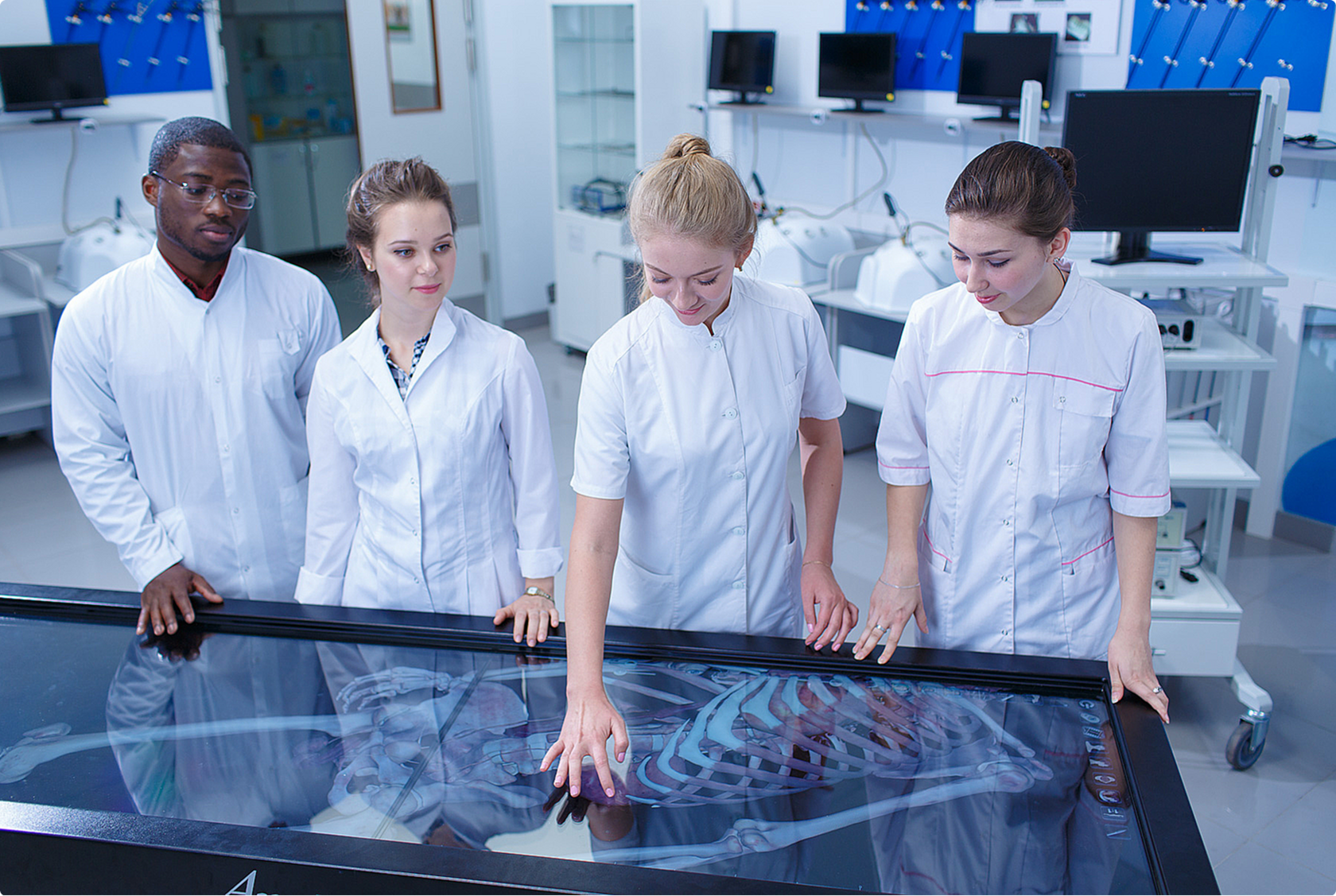
The program draws on two groups of teachers. The first are leading researchers, people who are actively engaged in scientific work and can show students how new knowledge is produced. The second are practicing clinicians, doctors who treat patients and bring the realities of clinical work into the classroom.
Combining both perspectives gives students a fuller picture of medicine. A researcher can explain why a treatment works and where the evidence is still uncertain; a clinician can show how that treatment is chosen and delivered for a specific patient. Learning from both helps students connect laboratory findings with bedside decisions, which is one of the central goals of the track.
The university describes its team as a group of outstanding scientists, recognized experts who have experience of international collaboration. For students, this means exposure to people who work with colleagues from other countries and follow developments far beyond Moscow.
Mentoring rather than lecturing
On many medical programs, contact with senior faculty is limited by the sheer number of students. The Leaders track is built differently. Training and mentoring from leading researchers and practitioner-teachers is listed among its core advantages, and the program emphasizes direct interaction with leading faculty members.
Mentoring takes several forms. In research, students carry out fundamental and applied projects under the guidance of leading teachers, learning to defend their results and prepare them for publication. In clinical training, they work on real cases with experienced mentors at leading Moscow medical institutions. In leadership training, they develop the management and communication skills needed to organize their own work, coach others and lead a team.
Personal curators and small groups
Alongside subject teachers, every student on the track has a curator. The curator’s job is to accompany the student throughout their studies: helping them plan an individual development path, keeping an eye on progress and pointing them toward opportunities that suit their interests.
This kind of personal support can be particularly valuable for international students. Studying medicine in a new country brings practical and academic challenges at the same time, and having a named person who knows your situation makes it easier to address problems early. For students from Hong Kong and elsewhere who are living far from home, a curator can be a steady point of contact.
Small-group teaching is the practical foundation of this model. When a class is compact, teachers can see how each student is reasoning, correct misunderstandings quickly and adapt the discussion to the group. Students, in turn, have more chances to ask questions, present cases and receive feedback.
Small groups also suit the leadership strand. Skills such as decision-making under uncertainty and leading a team are best developed through practice and reflection, which requires active participation rather than passive listening.
An interdisciplinary teaching environment
The faculty of the Leaders track works within a broader university community. Sechenov University brings together physicians, biologists, engineers and IT specialists, creating an environment where ideas move between disciplines and new technologies can be transferred into practice. Research at the university covers fields such as genomics, proteomics, regenerative medicine, neuroscience and artificial intelligence in medicine.
For students, this means that the people they learn from are often connected to projects at the frontier of their fields. It also opens the door to professional development beyond the classroom, including international conferences, internships and seminars, where students can practice scientific communication.
What students can take away
Close work with experienced teachers can shape a student’s direction long after graduation. Research mentoring can lead to scientific projects, and the habits formed during supervised clinical work carry over into residency or postgraduate study, both of which are paths the program mentions for graduates.
The specific names of faculty members are not listed here; for questions about who teaches particular parts of the program, contact the team directly. More about the track is available on the Leaders program page, our admissions section explains the application steps, and the contacts page lists phone numbers and the university address.
To learn more about teaching and mentoring on the track, visit https://healthleaders.sechenov.ru/ or send your questions to healthleaders@staff.sechenov.ru.
Questions?
Contact Us

